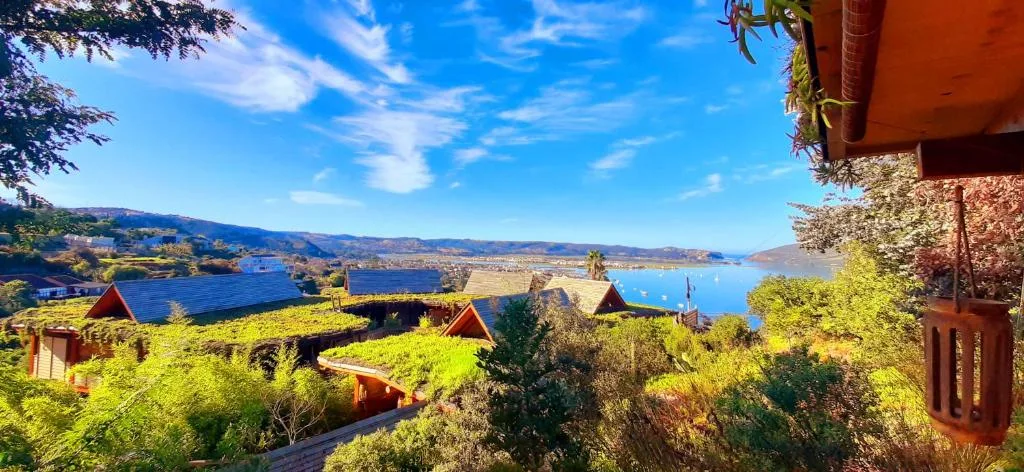
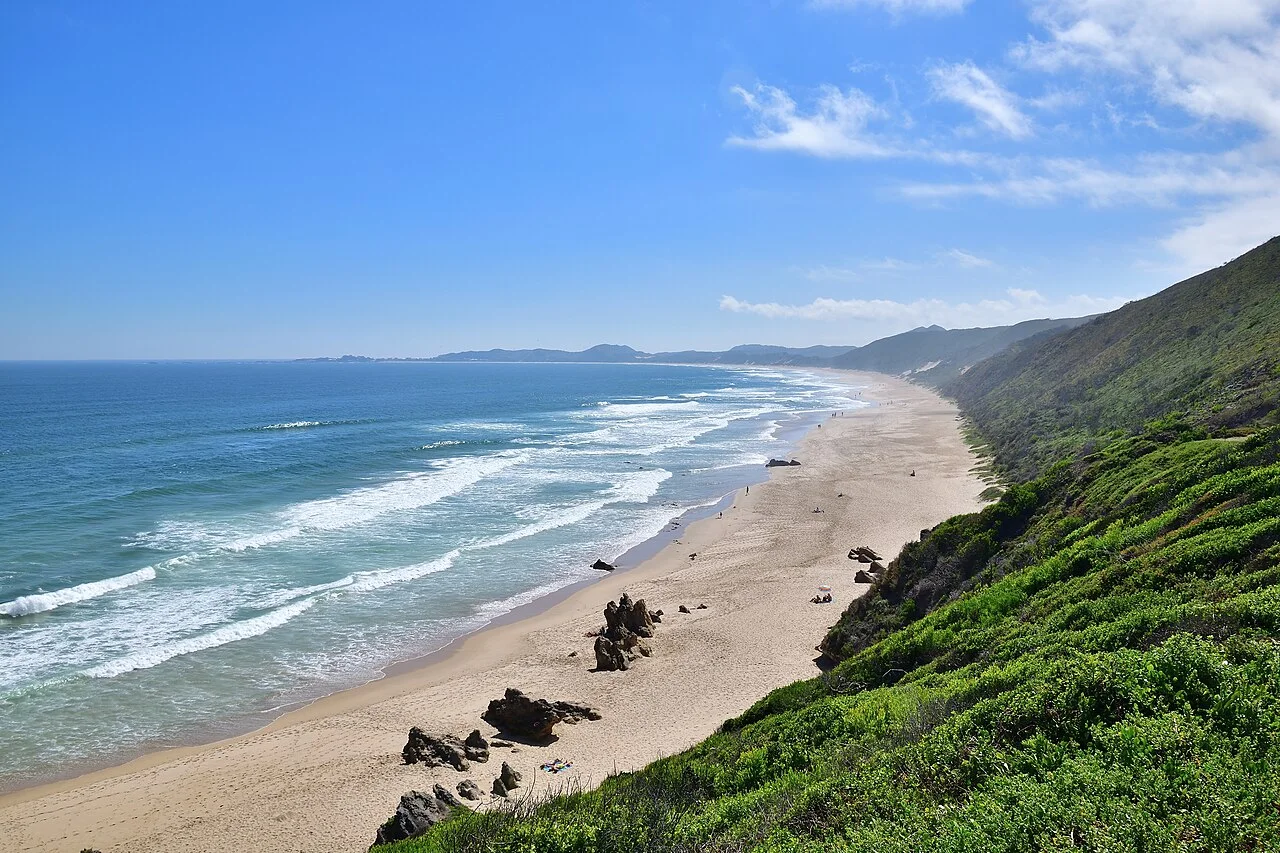
Brenton-on-Sea is a small beach village on the Western Head about 12 to 15 km west of Knysna — a 16 to 20 minute drive from town — and it's where Knysna sends its swimmers. The lagoon-and-forest town has no proper ocean beach of its own, so for actual sand-and-surf days locals head out over the Western Head to Brenton's 5 km curve of Blue Flag sand. If you've ever stood at the Knysna Heads viewpoint and looked west across the channel, that long stretch of white running off into the distance is it. This is the visitor's guide to that drive: where Brenton actually is, how to get there, why the beach is good, what happened to the butterfly that made it famous, and how to spend a half-day there without overstaying.
The rest of this piece is the detail — the road in, the swimming caveat, the walks worth doing, the butterfly story, where to eat, and how Brenton fits into a Knysna stay.
What is Brenton-on-Sea?
Brenton-on-Sea is a small residential beach village on the Western Head of the Knysna estuary — the same peninsula as Featherbed Nature Reserve, but on the opposite (ocean-facing) flank. Population is around 294 according to the 2011 Census, spread across 1.76 km² of clifftop houses, a handful of guesthouses, and three or four cafés.
It sits about 12 to 15 kilometres west of Knysna as a drive, depending on where you start. Visit Knysna's own page gives 12 km; the Wikipedia entry and municipal sources give 15 km. Either way, the drive is 16 to 20 minutes — the road runs out on the N2, ducks under the white bridge over the Knysna estuary, and loops south through Belvidere and Brenton-on-Lake before hitting the coast.
The name catches travellers out. The Brenton peninsula has two settlements that share the name:
- Brenton-on-Lake sits on the lagoon-facing (north) side of the peninsula, looking back across the Knysna estuary toward town. Quieter, residential, no beach.
- Brenton-on-Sea sits on the ocean-facing (south) side, with the actual surf beach. This is the one you've come to see.
Both villages are named after Sir Jahleel Brenton, the British Royal Navy officer who declared Knysna a harbour in 1818. The "Sea" / "Lake" suffix is the local shorthand for which side of the peninsula you're on.
How to get to Brenton-on-Sea from Knysna
There's only one road in, and the turn-off is easy to miss the first time.
Heading west on the N2 from Knysna, you'll cross the white bridge over the lagoon. About 1 km after the bridge, take the Brenton-on-Sea / Belvidere off-ramp. (Coming the other way — east from George — the same off-ramp is on your left just before the bridge.) The off-ramp loops you under the N2 and onto Brenton Road, which runs roughly 8 km through Belvidere Estate, past Brenton-on-Lake, and finally drops onto the coastal village.
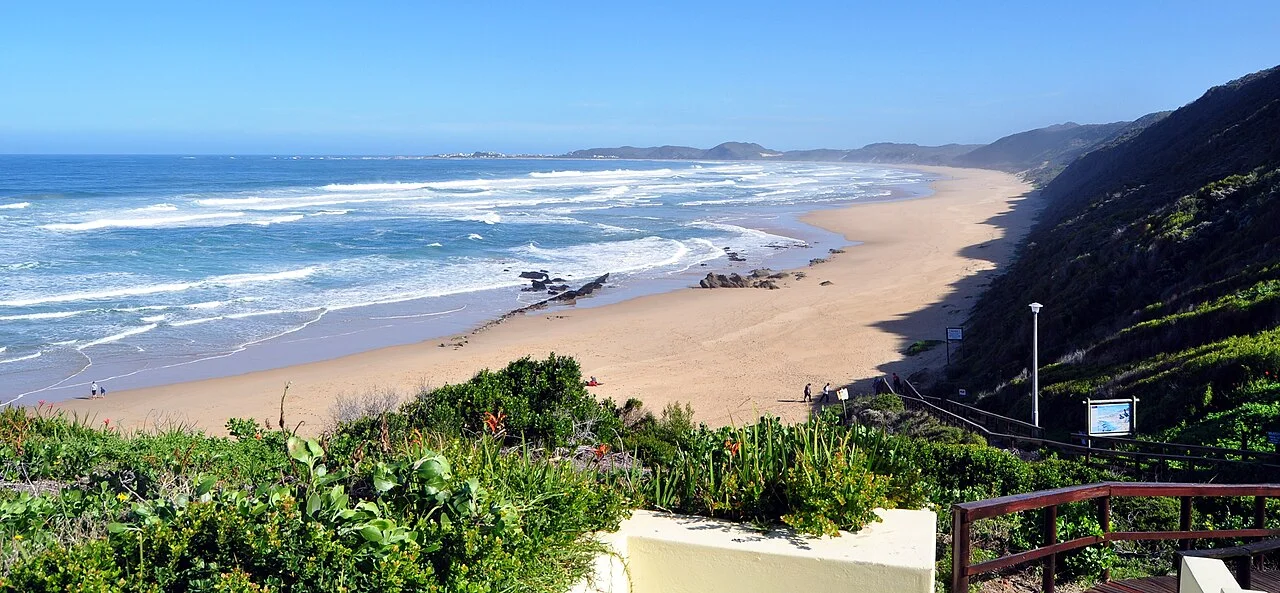
Once in the village, the spine road is State President C R Swart Drive. Follow it to the end — it terminates at Brenton Haven, the cluster of resort buildings above the main beach access. There's a wooden boardwalk down to the sand from the parking area, plus public toilets and an outside shower roughly halfway down the steps.
For the secluded coves — Die Blokke, Millionaire's Beach, Jaapse Baai — drop a turn early off Steenbras Street, park near the Sheer Cliffs duplexes, and access them via the cliff steps that are part of Fisherman's Walk (more on that below).
A couple of practical things worth knowing before you drive out:
- No supermarkets in the village. Visit Knysna spells this out — provision in Knysna town before you leave. There's a small convenience store (Shop on Sea) but it's not a substitute.
- Parking gets tight on December weekends. SA summer school holidays fill the main beach car park by 10 am.
- Cell signal is spotty in pockets along Brenton Road and on the clifftop. Download offline maps before you go if you're new to the area.
The beach — what it's actually like
Brenton-on-Sea is the reason you came. The beach is roughly 5 km long, an uninterrupted curve of white sand running west until it meets the Goukamma estuary at Buffalo Bay. Visit Knysna confirms the 5 km figure; the Brenton-on-Sea Ratepayers Association cites a slightly tighter 4.5 km for the walkable section. Either way, it's the single longest unbroken stretch of sand in greater Knysna.
The sand is soft, fine, pale — the kind that compacts properly underfoot at low tide and is good for long flat walks. The water is the standard cold Atlantic-influenced summer ocean: roughly 18-20°C in February, dropping to 14-15°C in winter. Visibility varies — most days you can see your feet in the shallows; on cleaner days you can see down to fish.
It's a Blue Flag beach, and has been for a number of years. Knysna Municipality lists it as one of the two Blue Flag beaches in greater Knysna (the other is Buffalo Bay, just along the same stretch). Blue Flag is the international clean-and-safe rating run by the Foundation for Environmental Education and audited locally by WESSA — it's a genuine standard, not a marketing badge.
The swimming caveat
This part matters. Brenton-on-Sea is a rip-current beach. The Ratepayers Association is explicit — "swimming can be dangerous… one can easily get caught in a riptide." Pink rescue buoys are mounted at intervals along the shoreline for exactly this reason.
The mitigation is the lifeguard service, which patrols a marked swim zone in front of Brenton Haven. Per the George Herald, the official cover runs 1 December to 31 January only — eight weeks at the peak of SA summer school holidays. Outside that window, you're an ocean swimmer with no patrol. We'd treat the beach as a paddling-and-walking beach for the other 44 weeks of the year, and a swim-between-the-flags beach during the holidays.
If you're a confident open-water swimmer used to SA conditions, the swell at Brenton is rarely above shoulder-height. If you're not, stay in the marked zone or swim instead at Bollard Bay on Leisure Island in Knysna — sheltered lagoon water, calm, ankle-deep for 10 metres out.
Walks worth doing at Brenton-on-Sea
The walking is the thing I'd come back for. Two routes stand out, and both are free, dog-friendly on lead, and have proper signage.
Fisherman's Walk
A clifftop trail running roughly 1 km along the headland west of the main beach, ending at four wooden viewing decks set into the fynbos. The Garden Route Adventure Guide lists the full circular as 2.2 km if you do the cliff out and the beach back.
The trail's signature feature is the 255 wooden steps that drop down the cliff to two secluded sand pockets — Die Blokke to the east, Millionaire's Beach to the west. Both are tidal — at high tide the rocks cut you off, so check the tide chart before you commit to the steps. The fourteen benches along the cliff are a pleasant place to sit with a coffee from the village; the four viewing decks are good for whale-watching in season.
Trailheads sit off Steenbras Street, with a small parking pull-out near the Sheer Cliffs duplexes.
Brenton-on-Sea to Buffalo Bay beach walk
The proper one. From the main Brenton beach access, walk west along the sand, past the cliff line, around the curve, and on toward Buffalo Bay — about 5 km one way. Two important constraints: it's a low-tide-only walk, because at high tide the surf reaches the cliffs in places and you lose the gap; and the backwash on the western half can be strong, so don't walk in soft sand right at the water line.
Time it for the two hours either side of low tide and you'll have a properly empty beach to yourself. Most people walk an hour and a half each way. Take water — the only café until you reach Buffalo Bay is the one you started from.
A more formal multi-day option is the Western Heads / Goukamma trail run by CapeNature inside the Goukamma Nature Reserve, which begins on the Buffalo Bay side and runs west. That's a different scale of trip — book through the reserve. For where Brenton sits in the wider Garden Route picture, our pillar guide covers the full coast and the towns either side.
The Brenton Blue butterfly — and what happened to it
Brenton-on-Sea was, until 2017, the entire global home of the Brenton Blue butterfly (Orachrysops niobe) — one of South Africa's rarest endemic insects. It's worth understanding what happened, because the butterfly is the reason Brenton makes it onto every wildlife list, and the current reality is that you almost certainly won't see one.
The species was first described in 1858, lost for over a century, then rediscovered in 1991 in a single fynbos patch on the Brenton peninsula. After a long campaign by the Lepidopterists' Society of Africa, the Brenton Blue Butterfly Special Nature Reserve was proclaimed on 4 July 2003 — initially 1.6 hectares, expanded later to 20+ via stewardship agreements with adjacent landowners. The species is highly specific: caterpillars feed on the rootstock of Indigofera erecta and depend on a co-evolved relationship with a particular ant species. Move either side of that triangle and the butterfly disappears.
By 2017, the adult population had dropped to fewer than 50 from a 2008 estimate of 150. Then the June 2017 Knysna fires burnt through the reserve. Four butterflies emerged that November and were photographed; as the Daily Maverick reported in February 2025, "none have been found since then, despite regular monitoring." The official SANBI Red List status is still Critically Endangered, but CapeNature and the conservation researchers who managed the reserve now treat extinction as the working assumption.
The reserve itself is closed to public tours and has been since the fire. If you're walking the village, you may see the boundary fence near the corner of W K Grobler Drive and Fynbosoord, but you won't see the butterfly. We mention it because every visitor asks, and because the conservation story is part of how this village earned its identity — not because it's something you can tick off a sightings list.
Where to eat in Brenton-on-Sea
The village is small and the food scene moves slowly — most of the same places have been here for years. Three are worth a stop:
- Butterfly Blu Restaurant — the village's flagship sit-down. Panoramic bay-view deck, named for the butterfly, dinner-and-drinks venue. Phone 044 630 0601 to confirm hours; it's been listed by Visit Knysna as the headline restaurant for several years.
- On Brenton Local Eatery — café-style, more casual, breakfast-and-lunch focus. 044 381 0304.
- Indigo Deli — deli-counter shop with prepared takeaway food. Useful if you want a sandwich and coffee for a Fisherman's Walk lunch.
- Shop on Sea — convenience-store-with-coffee. Not a destination but useful for forgotten ice or a meal-of-the-day takeaway.
For a proper dinner you'll usually drive back into Knysna — Thesen Islands and the Knysna Waterfront sit 15-20 minutes away and have considerably more options.
Brenton and the 2017 Knysna fires
Some context for what you're looking at when you drive into Brenton-on-Sea. In June 2017, the Knysna fires burnt 16,000 hectares across the Western Head and surrounds. Brenton-on-Sea, Brenton-on-Lake and Belvidere were entirely cut off by road as the fire ran end-to-end across the peninsula. Residents were evacuated by NSRI boat across the lagoon and by 4×4 convoys via the beach toward Buffalo Bay.
Local reporting in the Knysna-Plett Herald records that 99 houses in Brenton-on-Sea were affected — about 7.3% of the suburb's housing stock. Across greater Knysna, the fires killed seven people and caused billions of rands in damage.
Most of the visible scarring has grown out — fynbos recovers fast — but you'll still see new builds on cleared erven, and the Knysna Museums fire archive has the full record if you want to understand what residents went through. The Brenton Blue Butterfly Reserve story is the most visible long-term consequence; the village's housing stock has largely been rebuilt.
When to visit Brenton-on-Sea
The beach itself is year-round — the cliffs and the sand don't change much across seasons. What does change is the swim safety, the crowds, and what's around to see.
December to January — peak SA summer school holidays. Lifeguards on duty in the marked swim zone. Beach is busy on Saturdays and weekends; weekdays manageable. Parking pressure near Brenton Haven. Best window for actual swimming.
February to April — quieter, water still warm-ish (18-20°C), most cafés open. Probably the best balance of weather, crowds and swimming for someone who isn't tied to the school calendar.
May to August — winter. Whales start arriving along the Knysna coast: southern right and humpback migrate roughly June through November, with Bryde's whales resident year-round. Castle Rock — the offshore stack visible from the main beach — is a recognised whale-watching vantage. Expect cold mornings, wind, fewer people, and the cleanest light for photography.
September to November — spring. Wildflowers in the fynbos, pleasant air temperatures, lifeguards not yet on. Whale season still active.
The biggest seasonal traffic is the early-January and Easter windows — book a stay at least eight weeks ahead if you're tied to those dates, and have a plan B for parking on a 30°C Saturday.
Where to stay for a Brenton-on-Sea trip
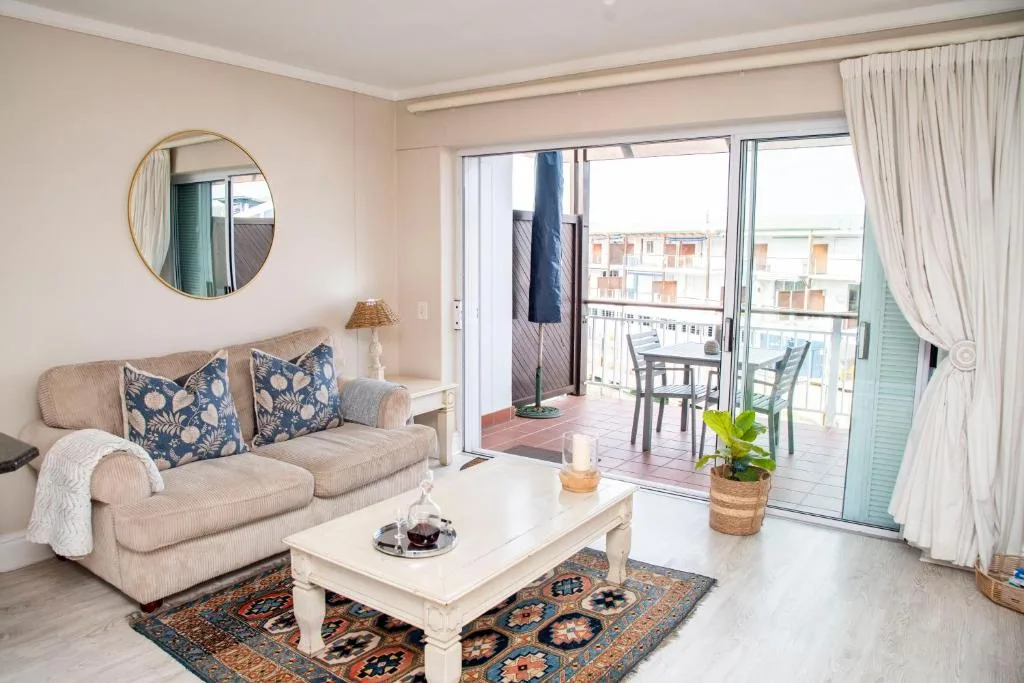
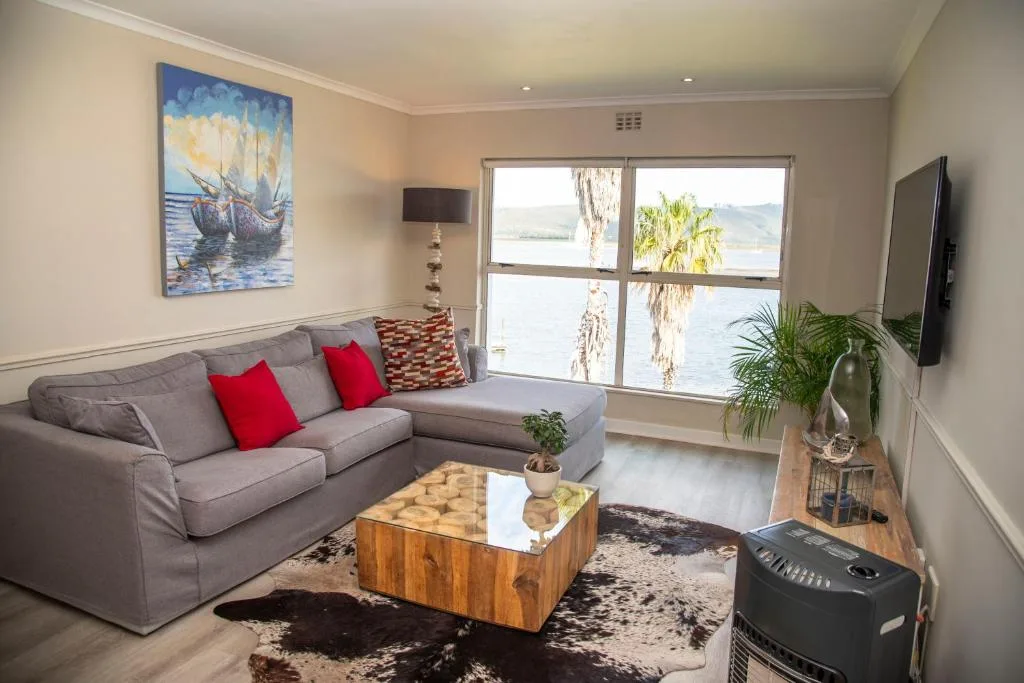
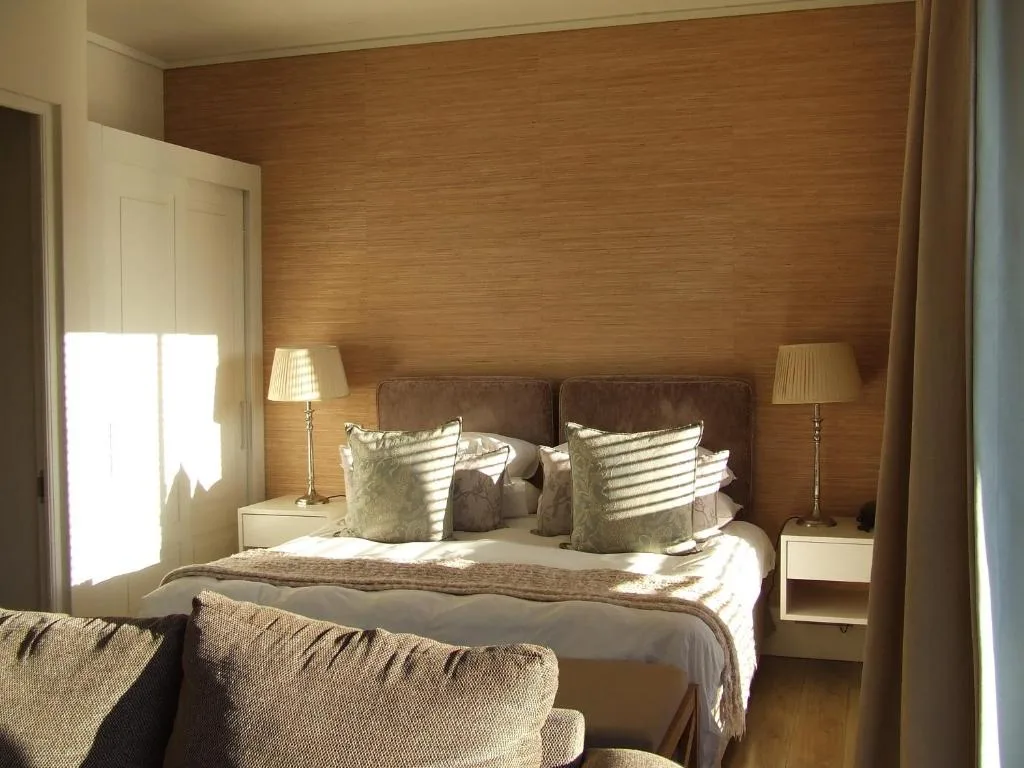
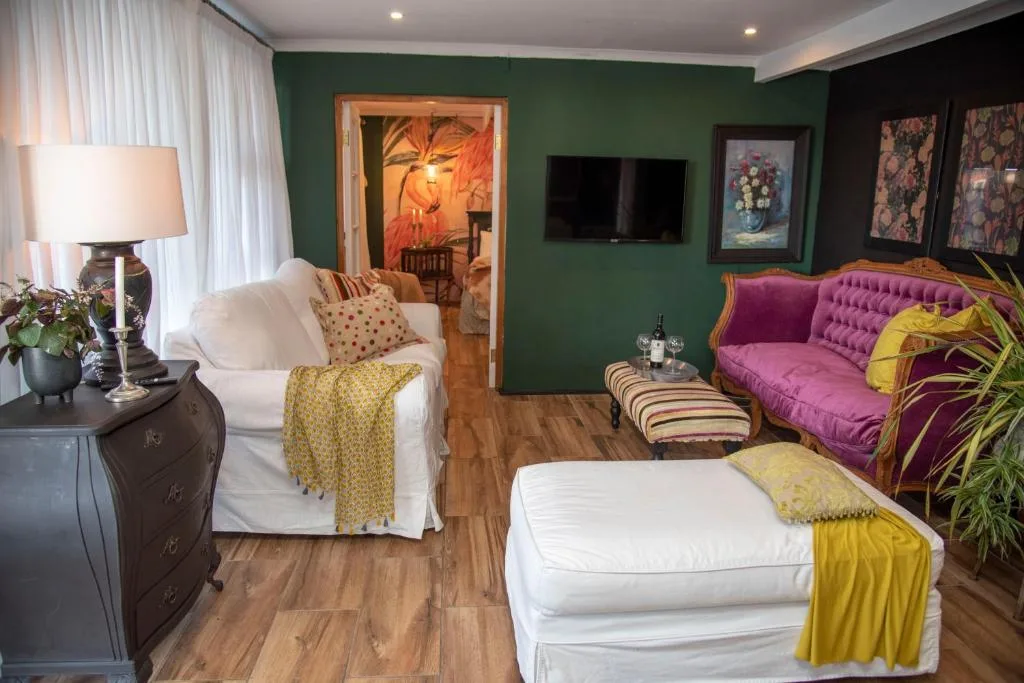
Most visitors stay in Knysna town — Thesen Islands, Knysna Quays, Paradise, Leisure Island — and drive out to Brenton for a half-day. The advantage is restaurants, supermarkets and the Heads viewpoint within walking distance back at base. Brenton itself has a handful of guesthouses, a small Booking.com presence, and a few self-catering cottages, but the supply is thin and prices in peak season match Knysna town.
If you want to stay closer to Brenton without committing to the village itself, Belvidere sits midway between Knysna and Brenton on the lagoon side — it's a quieter residential pocket with a couple of self-catering houses on the lagoon edge.
For the full Knysna self-catering inventory — Heads-side, Thesen, Leisure Island, Paradise, plus the Belvidere/Brenton edge — see our Knysna self-catering page, which lists every property we currently feature with rating filters and a map.
How Brenton-on-Sea fits into a Knysna trip
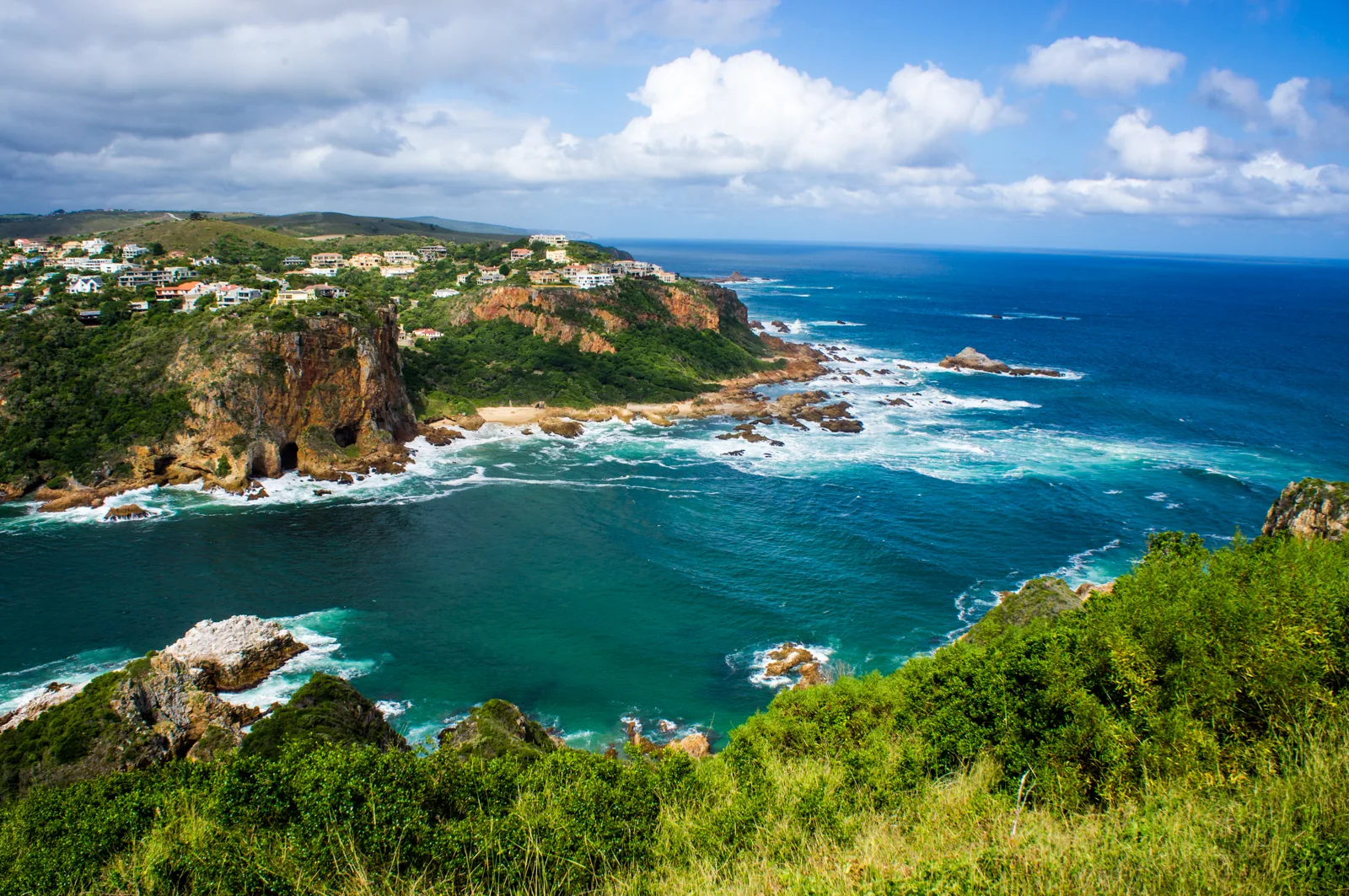
The Heads, the lagoon and Brenton-on-Sea are the three ocean-side stops in greater Knysna, and they make sense as a triangle rather than a queue.
One-night Knysna stay: Eastern Head at sunset, dinner on the Waterfront, and skip Brenton — there's not enough daylight to do it properly.
Two-night Knysna stay: Day one — Featherbed ferry in the morning, Knysna Waterfront for late lunch, Eastern Head sundowners. Day two — drive to Brenton-on-Sea after breakfast, walk Fisherman's Walk, lunch at Butterfly Blu or pack a deli sandwich, beach time in the afternoon, drive back for dinner.
Three-night Knysna stay: as above, plus a Robberg morning over in Plett, or a Goukamma walk from the Buffalo Bay end of the same beach.
If you've come with a family that came specifically for ocean swimming, weight the trip toward Brenton — it's the best swim beach within a 30-minute radius of Knysna. If you've come for the lagoon-and-forest experience, treat Brenton as a half-day excursion and don't expect it to be a destination on its own. If you're still deciding between bases, our Plett vs Knysna comparison covers which town suits which kind of trip.
A note on safety
Brenton-on-Sea is a quiet residential village and the beach is generally safe to use during daylight hours. Standard South African coastal-village care applies: don't leave valuables visible in cars at the cliff trailheads, lock the boot before you walk off down the dunes, and don't park in unlit side streets after dark. Visit Knysna's safety FAQ covers the broader Knysna context if you're new to the area.
In the water, the rip currents are the genuine risk. Stay in the lifeguard-marked zone in season, and outside it, treat the beach as a walking beach rather than a swimming one. Pink rescue buoys are mounted along the shoreline if you do see someone in trouble — they're free to grab and throw.
Sources
- Visit Knysna — Brenton-on-Sea — geography, beach, restaurants
- Knysna Municipality — Blue Flag beaches — Blue Flag confirmation
- Brenton-on-Sea Ratepayers Association — local services, swim safety
- Garden Route Adventure Guide — Brenton Fisherman's Walk — trail length, steps, decks
- SANBI Red List — Orachrysops niobe — Brenton Blue official status
- Brenton Blue Trust — Reserve — proclamation date, hectares
- Daily Maverick — How a fire undid decades of conservation — current butterfly status
- Daily Maverick — 2017 Knysna fires photo survey — fire impact on Brenton
- George Herald — Lifeguards need financial lifeline — lifeguard season dates
- Knysna-Plett Herald — Tally of destruction — Brenton-on-Sea housing-loss figure
- Wikipedia — Brenton-on-Sea — population, naming
Where Knysna stays sit
Every listing plotted, with attractions dotted around it. Tap a navy pill to see the stays in that cluster.
Frequently asked questions
What is Brenton-on-Sea known for?
Brenton-on-Sea is best known for two things — its 5-kilometre Blue Flag beach connecting to Buffalo Bay, and the Brenton Blue butterfly. The butterfly is one of South Africa's rarest insects, endemic to a small reserve in the village and now considered likely extinct after the 2017 Knysna fires destroyed its only habitat.
Is Brenton-on-Sea in Knysna?
Yes. Brenton-on-Sea is a small seaside village around 12-15km west of Knysna town, inside Knysna Local Municipality in the Western Cape. It sits on the Western Head — the same peninsula as Featherbed Nature Reserve. Drive time from central Knysna is 16-20 minutes via the N2 and Brenton Road.
Is it safe to swim at Brenton-on-Sea?
Inside the lifeguard-marked swim zone during peak season, yes. Outside it, no — the Brenton-on-Sea Ratepayers Association warns of frequent riptides and advises great care. Lifeguards patrol from 1 December to 31 January only. Outside those eight weeks, treat it as an ocean swim with no patrol.
Is Brenton-on-Sea worth visiting?
Yes, especially if you're staying in Knysna and want a proper ocean beach. Knysna itself is a lagoon-and-forest town with no real swimming beach in town; Brenton-on-Sea is its overflow valve — 16 minutes' drive, 5 kilometres of sand, lifeguards in summer, two or three good cafés and a clifftop walk. It's a half-day trip, not a destination.
Is the Brenton Blue butterfly extinct?
Officially Critically Endangered, but functionally likely extinct. The last confirmed sightings were four butterflies that emerged in November 2017, after the June 2017 fire destroyed the reserve. Despite regular monitoring since, none have been found. CapeNature and conservation researchers now treat extinction as the working assumption.
How far is Brenton-on-Sea from Knysna?
About 12-15 kilometres west of central Knysna, depending on where you start. Visit Knysna gives 12 km; Wikipedia and the municipality give 15 km. Drive time is 16-20 minutes via the N2 turn-off at Belvidere, then Brenton Road through Brenton-on-Lake to the coast.